4 Facets of Psychopathy: PCL-R Test Explained & Key Traits
The word "psychopath" often brings to mind scary characters from movies. But in psychology, it's a complex personality construct studied with scientific care. It isn't just about good or evil; it's a specific pattern of traits affecting how a person interacts with the world, processes emotions, and behaves. So, what are the scientifically recognized components?
To understand this personality structure, we have to move past stereotypes and look at a validated framework. The key tool here is the Psychopathy Checklist-Revised (PCL-R). It organizes the main traits into four distinct but related dimensions, or facets. Let's break down these four facets one by one—you'll see how they fit together. Exploring these concepts can be a powerful first step toward self-awareness or understanding others. To see where you may lie on this spectrum, you can explore our free test for a confidential assessment.
Understanding the PCL-R Framework: A Scientific Basis
First, a quick look at the tool behind it all: the PCL-R. Developed by renowned psychologist Dr. Robert Hare, the Psychopathy Checklist-Revised is a clinical rating scale. It's used by trained professionals, mainly in forensic settings, to assess the presence and severity of certain personality traits.
Our educational tool is inspired by the scientific principles behind such established models. By understanding the PCL-R’s structure, you gain insight into how experts approach this complex profile. This helps you move away from pop-culture myths and toward a more objective view.
What Are the Four Core Facets of This Personality Profile?
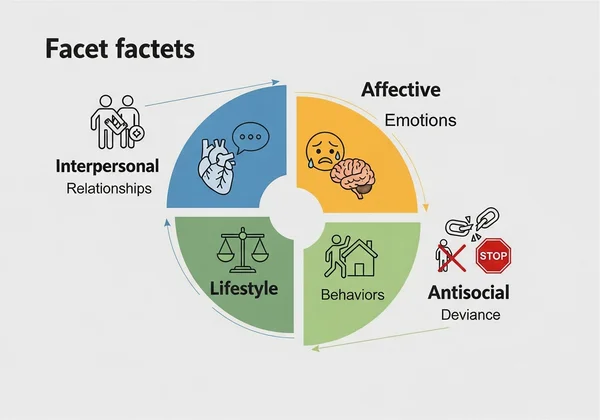
The PCL-R model groups 20 distinct traits into four fundamental facets. You can think of them as the four pillars that support this personality construct. They are:
-
Interpersonal: This facet describes a person’s social style—how they present themselves and interact with others. It's marked by charm, deceit, and a grandiose sense of self.
-
Affective: This facet relates to a person’s emotional life. It involves a deep lack of empathy, guilt, and remorse, along with shallow feelings.
-
Lifestyle: This covers a person's life patterns and choices. It is defined by impulsivity, irresponsibility, and a constant need for excitement.
-
Antisocial: This final facet addresses overt behavior. It’s about a persistent disregard for rules and social norms, often leading to criminal activity.
Why the PCL-R Remains the Gold Standard for Assessment
For decades, the PCL-R has been the top tool in research and clinical assessment. Its strength is its comprehensive nature and its proven reliability. It provides a standard language that lets researchers and clinicians worldwide study the same phenomenon consistently.
While online tests are not clinical diagnoses, those inspired by the PCL-R's structured approach offer a more scientifically grounded way to explore these traits. This method ensures the assessment is balanced and considers the whole picture, not just one or two shocking behaviors.
Facet 1: The Interpersonal Traits
The first facet, Interpersonal, is about outward presentation. It’s the mask that people with these traits often wear, which can be disarming and deceptive. Imagine a coworker who charms the boss but subtly undermines you—that’s the interpersonal facet at play.
Grandiose Sense of Self-Worth and Superficial Charm
Those strong in interpersonal traits often project an aura of huge ego and arrogance. They see themselves as superior and feel entitled to special treatment. This grandiosity is often paired with a smooth, engaging, and superficial charm.
They’re witty and articulate. This wins trust fast. But it’s not real warmth. It’s a tool for manipulation—to grab power, money, or praise.
Pathological Lying and Manipulativeness in Relationships
Deceit is a cornerstone of this facet. Pathological lying isn't just about telling occasional white lies; it’s a default mode of communication. The lies can be big or small, told with ease and no shame, even when easily disproven. Some call this "duping delight," where the person seems to enjoy fooling others.
This flows directly into being cunning and manipulative. They see people not as individuals with feelings but as pawns in their game. They are skilled at finding and exploiting others' weaknesses to get what they want. Often, they leave a trail of confused and hurt people behind them. Sound familiar in your life?
Facet 2: Affective Deficits and Emotional Blunting
If the Interpersonal facet is the mask, the Affective facet is what lies beneath: a profoundly different emotional reality. This dimension is often the hardest for people to grasp, as it involves a limited capacity for the very emotions that create human connection and morality.
Lack of Empathy, Guilt, and Remorse
This is perhaps the most defining feature of this personality pattern. A lack of empathy means they are unable to understand or share the feelings of others. They might cognitively know that someone is sad, but they don't feel it themselves.
This emotional void lets them hurt others without feeling bad. No guilt or remorse follows. Lie, cheat, or harm? They feel nothing like the rest of us. They might rationalize their behavior, blame the victim, or simply deny that any harm was done. They don’t regret their actions, only the consequences if they get caught.
Shallow Affect: A Limited Range of Emotions
While they may lack deep emotions like love or empathy, people scoring high on PCL-R traits can display feelings—but they are often shallow and short-lived. They might show dramatic bursts of anger or excitement, but these feelings are fleeting and lack depth.
Their emotional expressions can seem theatrical or insincere. That's because they are often mimicking what they’ve learned is the "appropriate" response in a situation. This limited emotional range prevents them from forming genuine, lasting bonds.
Facet 3: The Lifestyle Patterns
The Lifestyle facet moves from inner experience to outward behavior, focusing on an individual's approach to life. This dimension is characterized by instability, irresponsibility, and a relentless chase for self-gratification without regard for consequences.
Impulsivity and Irresponsibility: Living on the Edge
A core lifestyle trait is a powerful need for stimulation and a tendency to act on impulse. Those with these traits bore easily with routine and are constantly seeking new thrills, which can lead to reckless behavior.
This impulsivity is coupled with deep irresponsibility. They may struggle to hold a job, honor financial obligations, or fulfill commitments to family and friends. They chase what they want right now. Long-term duties? Others' needs? They don't care.
Parasitic Orientation and Lack of Realistic Goals
Many people with these personality patterns adopt a parasitic lifestyle, intentionally living off others. They may use charm or manipulation to get financial support from family, partners, or friends with no intention of giving back.
This is often tied to a lack of realistic, long-term goals. While they might talk about big plans for wealth or fame, they rarely put in the steady effort required to achieve them. Their focus is on the path of least resistance, which often means exploiting others. Exploring these patterns can be revealing, and a structured test can help identify them.
Facet 4: Antisocial Behaviors
The final facet, Antisocial, is the most overtly behavioral dimension. It includes a long-standing pattern of rule-breaking and a disregard for social norms and the rights of others. While not all individuals with these traits are violent criminals, a persistent history of antisocial behavior is a key component.
Early Behavioral Problems and Juvenile Delinquency
These patterns of antisocial behavior often begin early. A history of significant behavioral problems in childhood is common—such as persistent lying, theft, truancy, bullying, or cruelty to animals.
As they enter adolescence, these issues often escalate into juvenile delinquency. This isn't just typical teenage rebellion; it's a more serious and persistent pattern of violating rules and laws, setting the stage for adult antisocial conduct.
Criminal Versatility and Recidivism
In adulthood, the antisocial facet shows up as criminal versatility. This means they are likely to engage in various types of criminal acts—from fraud to more serious offenses—rather than specializing. Their criminality is often opportunistic and driven by impulse.
Furthermore, they have high rates of recidivism, meaning they are very likely to re-offend after being released from custody. Punishment is often ineffective because their decision-making is not guided by a fear of future consequences.
Beyond the Facets: The Spectrum and Your Insights
Understanding the four facets provides a detailed map of this personality construct. However, it's crucial to remember that these traits exist on a spectrum. Many people may show some of these characteristics to a minor degree without having a diagnosable disorder.
How These Traits Manifest in Daily Life
You don't have to be a criminal to have certain PCL-R traits. A manipulative colleague who uses charm to take credit for your work may be displaying Interpersonal traits. A partner who never apologizes or seems to feel guilty might show Affective deficits. A friend who is constantly in debt and jumps from one "get rich quick" scheme to another could be demonstrating Lifestyle traits. Recognizing these patterns is the first step.
The Importance of a Structured Assessment for Self-Understanding
Because these traits are complex, casual observation is unreliable. A structured assessment tool, even an educational one, can provide a more objective perspective. It helps you move beyond a single label and see how different traits might contribute to your overall personality.
A scientifically-inspired test provides a confidential and accessible way to start this journey. If you're curious about your own traits, why not take our free test to gain preliminary insights?
Integrating the Facets: A Deeper Understanding
The four-facet model—Interpersonal, Affective, Lifestyle, and Antisocial—provides a comprehensive and scientifically grounded framework. It shows us that this personality structure is not a one-dimensional caricature but a combination of manipulative social skills, a profound lack of emotion, an unstable lifestyle, and rule-breaking behavior.
This knowledge empowers you to see beyond stereotypes and recognize specific patterns in yourself or others. True understanding is the first step toward meaningful insight.
Ready to explore these traits in a structured, confidential way? Start Your Psychopathy Test today and unlock a deeper understanding with our optional AI-powered report.
Frequently Asked Questions About Psychopathy Facets & Assessment
What are the 4 types of psychopathy?
It's a common misunderstanding that there are distinct "types." Instead, clinical models like the PCL-R describe four facets or dimensions: Interpersonal (charm, manipulation), Affective (lack of empathy, guilt), Lifestyle (impulsivity, irresponsibility), and Antisocial (rule-breaking, criminal behavior). A person's score is based on how strongly they exhibit traits across all four areas.
How do I know if I'm a psychopath?
Self-diagnosis isn't reliable for something this complex. Only a trained pro can do a real assessment—with interviews and tools. However, for personal insight, you can use an online screening tool to see where you might fall on the spectrum of these traits. To take the first step in a confidential environment, try our assessment.
What is the difference between a psychopath and a sociopath?
These terms are often used interchangeably, but they have different origins. "Psychopathy" is a clinical construct defined by a specific set of traits, as measured by tools like the PCL-R. "Sociopath" is an older, less formal term. It's often used to describe individuals whose antisocial behavior is believed to come more from their environment (like a traumatic upbringing). In modern diagnostics (like the DSM-5), both would likely fall under Antisocial Personality Disorder (ASPD).
Can you test for psychopathy?
Yes, but it's important to distinguish between clinical assessment and online screening. A formal diagnosis is done by a qualified professional using instruments like the PCL-R. Online tests, like the one on our site, are educational screening tools. They are designed to provide preliminary insights into your traits based on a scientifically-inspired framework. Our online test is a great starting point for self-exploration.