Can Psychopaths Love: Understanding Emotional Capacity & Relationships
Love is often defined by deep emotional connection, vulnerability, and empathy. But when you are dealing with someone who displays psychopathic traits, these definitions become complicated and confusing. Whether you are questioning your own emotional experiences or trying to understand a partner's shifting behavior, the question "can psychopaths love?" rarely has a simple yes or no answer.
This guide explores the science behind psychopathic attachment, how it differs from neurotypical love, and what relationships with psychopathic individuals actually look like. By understanding the distinction between cognitive mimicry and genuine affection, you can gain clarity on your own situation. If you are unsure where you or your partner stand, you might want to start with a psychopathy test to better understand these personality patterns.

The Short Answer: Can Psychopaths Fall in Love?
The straightforward answer to "can psychopaths love" is that it depends entirely on how you define "love."
If you define love as a selfless, deep emotional bond where one person cares about the well-being of another as much as their own, the answer is generally no. Individuals with high levels of psychopathy typically lack the emotional hardware required for this type of bonding.
However, if you define love as a strong infatuation, possessiveness, or a need for a partner's validation, then yes, psychopaths can experience this. They often form what clinicians call a "psychopathic bond."
Romantic Love vs. Psychopathic Bond
It is crucial to distinguish between healthy romantic love and the attachment style seen in psychopathy.
- Healthy Love: Involves mutual vulnerability, trust, and emotional empathy. You feel the other person's pain and joy.
- Psychopathic Bond: Often driven by utility, stimulation, or possession. The partner is viewed more as an object that provides value (status, sex, money, or attention) rather than an equal human being.
Why Infatuation is Mistaken for Love
Psychopaths are prone to boredom and constantly seek stimulation. In the early stages of a relationship, they may experience an intense "high" or obsession with a new partner. This can look and feel exactly like falling in love. They may be excited, attentive, and physically affectionate.
However, this is usually dopamine-driven excitement, not oxytocin-driven bonding. Once the novelty wears off, the "love" often evaporates instantly, leaving their partner confused and heartbroken.
Cognitive vs. Emotional Empathy: The Mechanism Behind the Mask
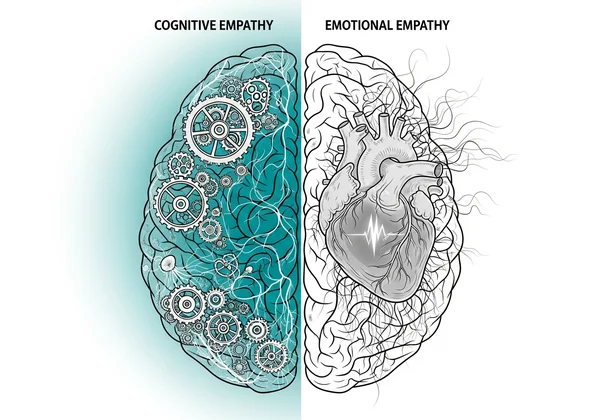
To truly answer "can psychopaths love," we must look at the brain's empathy circuits. This is the "engine room" of emotional connection. Most people have two types of empathy, but psychopaths usually only possess one.
Cognitive Empathy: The Ability to Understand
Cognitive empathy is the ability to intellectually understand what someone else is feeling. It is like reading a map. A psychopath can look at you crying and calculate, "She is sad because I yelled. To stop the crying, I should apologize."
They know the rules of love. They know that flowers mean affection and that listening implies care. This allows them to mimic loving behaviors perfectly, even if they don't feel the underlying emotion.
Emotional Empathy: The Missing Connection
Emotional empathy is the ability to feel what someone else is feeling—to have a visceral reaction to their pain or joy. This is where the disconnect happens.
Research suggests that the amygdala (the brain's emotional center) functions differently in those with psychopathic traits. They might see your pain, but it doesn't trigger a sympathetic response in them. This absence of emotional contagion is why they can turn their "love" on and off like a light switch.
Visual Spectrum Comparison: Healthy Love vs. Psychopathic Attachment
| Feature | Healthy Love | Psychopathic Attachment |
|---|---|---|
| Primary Motivation | Connection, growth, mutual support | Control, utility, stimulation |
| Response to Pain | Shared sadness, desire to comfort | Indifference or annoyance |
| Conflict Style | Compromise to restore harmony | "Win at all costs," blame-shifting |
| Consistency | Stable affection over time | High intensity followed by cold withdrawal |
| View of Partner | An equal, independent person | A possession or extension of self |
How Do Psychopaths Show Love? Recognizing Behavioral Patterns
If they lack emotional empathy, how do psychopaths show love? In many cases, they put on a performance that is more convincing than reality. Understanding these behavioral patterns can help you separate genuine affection from manipulation.
The "Soulmate" Phase: Love Bombing
The most common way a psychopath initiates a relationship is through "love bombing." This is an overwhelming amount of affection, compliments, gifts, and attention in a very short period.
- Premature Commitments: Talking about marriage or moving in together within weeks.
- Intense Flattery: Telling you that you are the only person who has ever understood them.
- Constant Contact: Texting and calling 24/7 to create a sense of dependency.
This isn't just enthusiasm; it is a strategy to hook you emotionally before you notice the red flags.
Mirroring: Reflecting Your Identity
Psychopaths are chameleons. During the "courting" phase, they will mirror your interests, values, and insecurities.
- If you love hiking, they suddenly love hiking.
- If you have a history of trauma, they will share a similar (often fabricated) story to create a false bond.
You aren't falling in love with them; you are falling in love with a carefully crafted reflection of yourself.

Transactional Affection
Over time, you may notice that their affection becomes transactional. "Love" is given only when you are serving a purpose—boosting their ego, providing money, or making them look good socially. If you stop providing that value, or if you challenge them, the affection is immediately withdrawn.
The 3 Stages of a Psychopathic Relationship Cycle
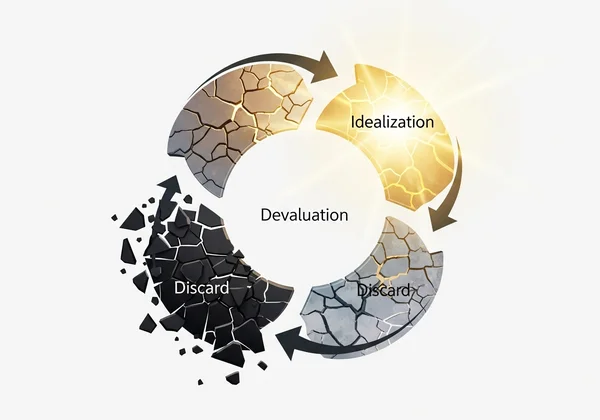
One of the most painful aspects for partners is the predictable cycle of these relationships. Unlike normal relationships that have ups and downs, relationships with psychopathic individuals often follow a rigid three-stage script: Idealize, Devalue, Discard.
Stage 1: Idealization (The Hook)
As mentioned above, this is the love bombing phase. You are placed on a pedestal. They make you feel perfect, chosen, and adored. This stage creates a powerful biochemical bond in your brain, similar to addiction. You believe you have found your soulmate.
Stage 2: Devaluation (The Erosion)
Once they know you are hooked, the mask slips. The adoration turns into subtle criticism.
- Gaslighting: They deny things they said or did, making you doubt your memory.
- Triangulation: They compare you to an ex-partner or a new coworker to make you jealous and insecure.
- Coldness: The warmth you were addicted to is replaced by indifference. You start working harder to "win back" the person they used to be.
Stage 3: Discard (The Detachment)
When they have extracted what they need, or found a new source of supply, the discard happens. It is often abrupt and brutal. They may end the relationship without closure, ghost you, or treat you like a complete stranger. Because they lack emotional empathy, they do not experience the typical grief of a breakup. They simply move on.
Interactive Checklist: Signs You Are in This Cycle
- Did the relationship move much faster than any you’ve had before?
- Do you feel like you are constantly "walking on eggshells"?
- Are you confused by how someone who adored you now seems to despise you?
- Do they punish you with silence when you bring up concerns?
- Do you feel like you are losing your sense of reality?
If you checked more than three of these boxes, you may be caught in a cycle of emotional manipulation.
Specific Scenarios: Family, Children, and Pets
The question "can psychopaths love their family" or pets is complex. While they struggle with emotional empathy, they can still exhibit protective or possessive behaviors over their "clan."
Parenting Style: Children as Extensions of Self
Can a psychopath love their child? Yes, but it often looks different. They may view their children as extensions of themselves—"mini-mes" that prove their superior genetics.
- Possessiveness: They may be fiercely protective, not out of care for the child's feelings, but because the child belongs to them.
- Control: As the child grows and develops a separate personality, the psychopathic parent may become controlling or critical if the child no longer reflects their "perfect" image.
Family Dynamics: Loyalty vs. Bond
They may show loyalty to parents or siblings, but this is often based on a code of conduct or tribalism rather than deep affection. "We stick together" replaces "I care about how you feel."
The Role of Pets
Surprisingly, some individuals with psychopathic traits display affection toward animals. Animals provide unconditional adoration without the complex emotional demands of humans. However, this is not universal; some may also view animals as objects to be controlled or neglected if they become inconvenient.
Can a Psychopath Learn to Love? (Therapy & Outlook)
Many partners ask, "Can a psychopath learn to love if they go to therapy?" This comes from a place of hope, but it requires a realistic outlook.
Behavioral Management vs. Emotional Change
Psychopathy is a personality structure, not a temporary mood disorder. You cannot "teach" emotional empathy to a brain that isn't wired for it, much like you can't teach a colorblind person to see red.
However, through Cognitive Behavioral Therapy (CBT), some individuals can learn behavioral management. They can cognitively learn that "hurting my partner leads to me being lonely/losing status," and therefore choose to act more kindly. This is a choice based on logic, not a feeling based on empathy.
Can a Relationship Be Sustainable?
For a relationship to work, the partner usually has to accept that they will never receive deep emotional reciprocity. It requires firm boundaries and often a transactional agreement. For most people seeking genuine connection, this is emotionally unsustainable in the long term.
Is it Love or Manipulation? Gaining Clarity
Living in the shadow of these questions can be exhausting. You might find yourself analyzing every text message, looking for signs of the "old them," or wondering if you are the one imagining things.
Confusion is often the biggest symptom of being in a relationship with a high-conflict personality. When words and actions don't match, your intuition raises an alarm.
Why Self-Reflection is the Next Step
If you recognize these patterns in your relationship—or perhaps within yourself—objective information is your best tool. It is difficult to see the picture when you are inside the frame. Stepping back to assess behavioral traits systematically can validate your reality.
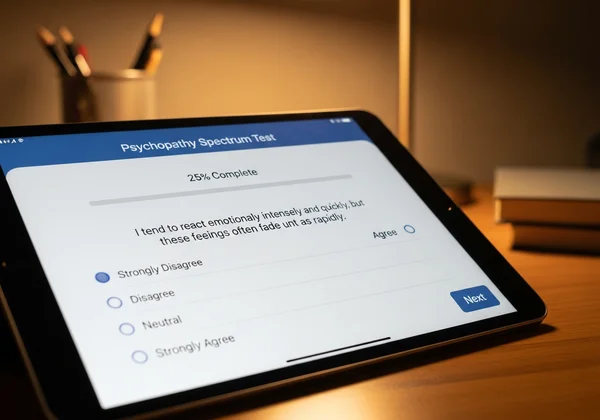
You don't have to stay in the dark. You can take a free psychopathy spectrum test to analyze these personality traits objectively. This isn't a medical diagnosis, but a way to organize your observations and understand where certain behaviors fall on the psychopathy spectrum.
Conclusion: Navigating Relationships and Self-Awareness
So, can psychopaths love? They can experience excitement, attraction, and possessiveness, but they rarely experience the selfless, empathetic love that sustains healthy relationships. Their "love" is often a simulation—perfectly mirrored but emotionally hollow.
Understanding this distinction is not about labeling someone as "evil." It is about protecting your own emotional well-being. Whether you are a partner trying to make sense of a painful discard, or an individual exploring your own emotional range, knowledge is the first step toward stability.
If you are ready to gain more insight into these complex personality patterns, analyze your personality traits with our educational resources to better understand the spectrum of human behavior.
Frequently Asked Questions
Can a psychopath cry from genuine sadness?
While psychopaths can cry, it is often due to frustration, anger, or self-pity rather than genuine sadness or empathy for others. They may also use tears as a manipulation tactic to garner sympathy.
Can two psychopaths fall in love with each other?
Two individuals with psychopathic traits can form a relationship, often called a "convenience alliance." These relationships are usually transactional and practical, lacking emotional depth but potentially lasting if both parties benefit from the union.
Do psychopaths experience heartbreak when a relationship ends?
Generally, no. Because they do not form deep emotional bonds, they rarely experience the grief or "heartbreak" typical of a breakup. Instead, they may feel anger at losing a "possession" or ego injury, but they typically move on very quickly to a new source of supply.
Is it possible to have psychopathic traits and still care?
Yes. Psychopathy exists on a spectrum. Someone with mild traits might struggle with empathy but still have the capacity for some level of care and loyalty, whereas someone on the extreme end (clinical psychopathy) will have significant deficits in connecting with others.