Psychopathy Test Ethics: What to Know Before Taking a Psychopathy Test
The rise of online psychological assessments has made self-discovery more accessible than ever before. With just a few clicks, you can explore the deepest parts of your personality from the comfort of your home. However, this accessibility comes with important questions about ethics, accuracy, and the responsible use of data. If you are considering taking a psychopathy test online, you are likely wondering: How reliable are these results, and what should I do with the information?
Many people feel a mix of curiosity and anxiety when they search for personality insights. You might be worried about your own emotional patterns, or perhaps you are a student or professional looking for a reliable screening tool. Understanding the ethical framework behind these tools is the first step toward a healthy assessment journey. This article provides a transparent examination of the ethical considerations and limitations of online testing, helping you make informed decisions.
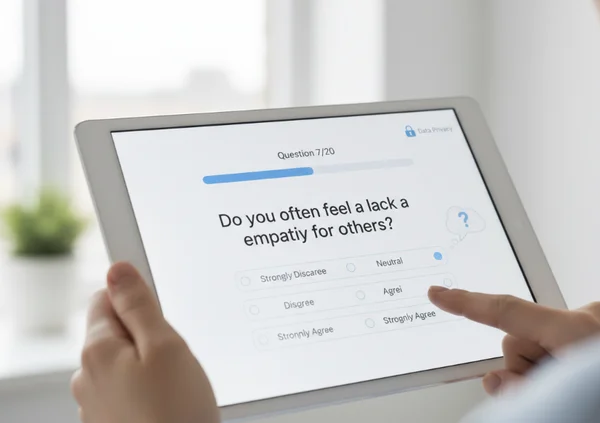
Before diving into the details, it is important to remember that a digital tool is a starting point, not a final destination. If you are ready to explore your personality traits in a safe and structured way, you can start your test on our platform today. We prioritize your privacy and provide scientific context for every result.
The Science Behind Online Psychopathy Testing
Modern online assessments are not just random quizzes. They are often built upon decades of psychological research. To understand the ethics of testing, we must first look at the scientific foundation that makes these tools useful for the general public.
How Valid Are Online Assessments Compared to Clinical Evaluations?
It is vital to distinguish between a clinical diagnosis and an online screening. A clinical evaluation is a deep, multi-hour process. It's usually conducted by a licensed psychologist or psychiatrist using the Hare Psychopathy Checklist-Revised (PCL-R). This process involves a detailed interview and a review of historical records.
In contrast, an online psychopathy spectrum test is a self-report tool. This means the accuracy depends on your honesty and self-awareness. While an online test cannot provide a formal medical diagnosis, it can be highly valid as a "screening tool." These tools are designed to identify traits and patterns that suggest you might fall somewhere on the psychopathy spectrum. They offer a "snapshot" of your personality that can guide further personal reflection or professional consultation.
Understanding the Validity of Digital Psychopathy Screening Tools
When we discuss "psychometric properties," we're talking about reliability and validity. A reliable test produces consistent results over time. A valid test actually measures what it claims to measure—in this case, traits like low empathy, impulsivity, or boldness.
Many reputable online tools, including ours, are inspired by the Levenson Self-Report Psychopathy Scale. This scale was specifically created for use in non-institutional settings. It focuses on primary psychopathy (selfishness and lack of remorse) and secondary psychopathy (impulsivity and a chaotic lifestyle). By using these established frameworks, digital tools provide a structured way for users to see your results based on recognized scientific models rather than guesswork.
The Evolution of Digital Psychopathy Assessment
Remember when psychological testing meant filling out endless paper forms? Today's digital assessments have transformed how we explore personality traits. In the past, only professionals had access to these scales. Today, technology allows for a more interactive experience.
Digital testing has evolved to offer more than just raw scores. Our platform uses AI-driven insights to interpret your data. Instead of simply labeling your score as "high" or "low," our system explains what these traits mean in your daily life. This evolution makes the science of personality more inclusive and easier to understand for the average person. If you want to see how these modern methods work, you can try our tool to get a deeper look at your own traits.
Ethical Considerations in Online Psychopathy Assessment
Ethics in psychological testing is about more than just following rules; it is about protecting the well-being of the user. Because the term "psychopath" carries a heavy social stigma, assessment platforms have a significant responsibility to handle the topic with care.
Informed Consent and the Responsibility of Assessment Platforms
When you undergo testing in a clinical setting, healthcare professionals ensure you understand exactly what the test measures and how your results might be used. Online, the responsibility of the platform is to be transparent. Users should know that the test is for educational and informational purposes.
Ethical platforms clearly state that their tools are not a substitute for medical advice. This transparency ensures that you are not misled into thinking a 10-minute questionnaire is the same as a doctor’s visit. Before you take the test, a responsible site will always provide clear instructions and disclaimers to ensure you are comfortable with the process.
Managing Expectations: From Screening Tool to Clinical Diagnosis
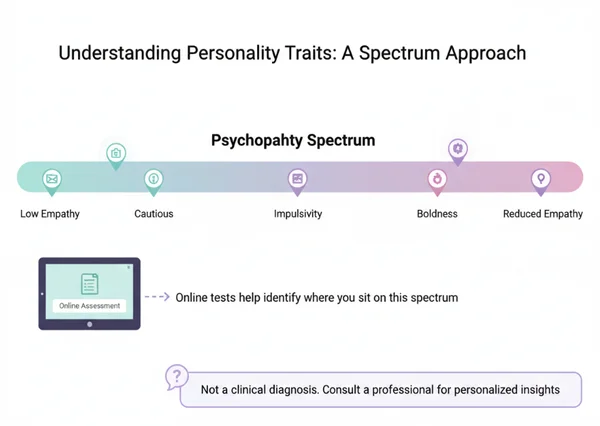
One of the biggest ethical challenges is managing user expectations. When someone takes a sociopath test or a psychopathy scale, they are often looking for a label. However, personality is complex and exists on a spectrum. Someone might have high "boldness" traits—which are common in successful leaders—without meeting the criteria for a personality disorder.
That's why we emphasize understanding specific traits rather than applying potentially misleading labels to your personality. By explaining how certain behaviors impact relationships and work, platforms help users move away from fear and toward self-improvement. This distinction helps prevent "self-labeling," which can lead to unnecessary distress. The goal of a screening tool is to open a door to self-awareness, not to close a door on your identity.
Cultural Sensitivity and Global Assessment Standards
Psychology is not "one size fits all." Traits that are seen as assertive in one culture might be viewed as aggressive in another. Ethical online testing must account for these differences. This is why multi-language support and global accessibility are so important.
A high-quality psychopathy checklist test should be designed to be as neutral as possible. By offering assessments in multiple languages, including English, Spanish, Japanese, and others, platforms ensure that people from different backgrounds can access these insights without cultural bias clouding the results. This global approach is essential for maintaining high ethical standards in the digital age.
Privacy, Data Security, and Your Test Results
Privacy is perhaps the most common concern for people looking for a free psychopathy test. Because of the sensitive nature of the topic, users need to know that their data is handled with the highest level of security.
How Your Psychopathy Test Data is Protected
When you participate in an online assessment, your data should be encrypted and protected. An ethical platform will never sell your personal information to third parties. Most reputable sites use secure servers and industry-standard encryption to ensure that your answers stay between you and the system.
At Psychopathytest.org, we believe that your journey of self-discovery should be private. We do not require a complex registration process for the initial assessment. This minimizes the amount of personal identifying information you need to share, allowing you to start the test with peace of mind.

The Limits of Anonymity in Digital Psychological Assessment
While platforms strive for anonymity, it is important for users to understand how digital footprints work. Most online tools use cookies or session IDs to ensure you can finish the test without losing your progress. However, true anonymity is a partnership.
To protect your own privacy, it is always a good idea to use a private browser window if you are on a shared computer. Ethical platforms are honest about what they track (such as general location or device type) to improve the user experience, while keeping your specific test answers confidential. Knowing these limits allows you to take a pclr test or screening tool more confidently.
What Happens to Your Results After You Complete the Test?
After you finish answering the questions, you usually receive an immediate summary. On our site, you have the option to unlock an AI-powered personalized report. This report goes much deeper than a simple score, offering advice on challenges and strengths.
From an ethical standpoint, your results should be yours to control. You should be able to save your report or delete your session data. We ensure that the data collected during the test is used solely to generate your insights and improve the accuracy of our scientific models. If you are curious about what your personality profile looks like, you can see your results right now in a secure environment.
Navigating Ethical Psychopathy Testing Responsibly
The journey into your own psychology is a powerful experience. When done correctly, taking an online test can lead to significant personal growth, better relationships, and a clearer understanding of your place in the world. However, it must be approached with a sense of responsibility.
To maximize the value of an assessment, look for platforms that:
- Reference scientific models like the PCL-R or Levenson scale
- Clearly state their tools are for screening, not clinical diagnosis
- Prioritize user privacy and data encryption
- Provide context and actionable advice rather than just a raw score
By following these guidelines, you can explore the psychopathy spectrum without fear. Whether you are a curious individual, a student, or someone concerned about a relationship, these tools offer a bridge to deeper understanding. If you are ready to take that step, we invite you to use our test today.
FAQ Section
Can an online test definitively diagnose psychopathy?
No, an online test cannot provide a clinical diagnosis. Only a licensed mental health professional, such as a psychiatrist or psychologist, can diagnose psychopathy or Antisocial Personality Disorder (ASPD). Online tools are designed for screening and educational purposes. They help you identify traits that may warrant further discussion with a professional. You can start your test to see where you sit on the spectrum for personal information only.
How private are my test results on your platform?
We take privacy very seriously. Our platform uses encryption to protect your data, and we do not require personal identification for the basic test. We do not sell your data to advertisers. Your results are generated for your eyes only, and you have control over how you use that information.
When should I seek professional evaluation instead of an online test?
You should seek a professional evaluation if your traits are causing significant distress in your life, such as legal issues, the inability to maintain relationships, or harmful behavior toward others. While a psychopathy test is a great way to begin your research, it is not a solution for mental health crises. If you feel overwhelmed, please consult a local therapist or counselor.
Are online psychopathy tests culturally biased?
Some tests can be biased if they were only developed for one specific population. However, our platform aims for global relevance by using scientifically recognized scales that have been studied across different cultures. We also offer our free online test in over 15 languages to ensure accessibility for a diverse global audience.
How can I tell if an online psychopathy test is ethical and scientifically sound?
An ethical test will always include a disclaimer stating it is not a medical diagnosis. It will also be transparent about its privacy policy and the scientific models it is based on (like the PCL-R concepts or the Levenson Self-Report). Avoid sites that make "clickbait" claims or promise to "cure" you. Instead, look for tools that offer balanced, AI-driven insights focused on self-discovery.