Psychotic vs Psychopathic: Key Differences, Traits, and Misconceptions
Psychotic vs psychopathic is one of the most common mental-health word mix-ups, and the confusion can make real experiences harder to understand. In plain terms, psychotic describes symptoms involving a break or disruption in contact with reality, such as hallucinations, delusions, or disorganized thinking. Psychopathic describes a pattern of personality traits, often involving low empathy, shallow remorse, manipulation, impulsivity, or persistent disregard for others. Neither word should be used casually to label someone. If you are exploring personality patterns in yourself, an educational resource like a private psychopathy self-reflection tool can support reflection, but it cannot replace a qualified mental-health evaluation.
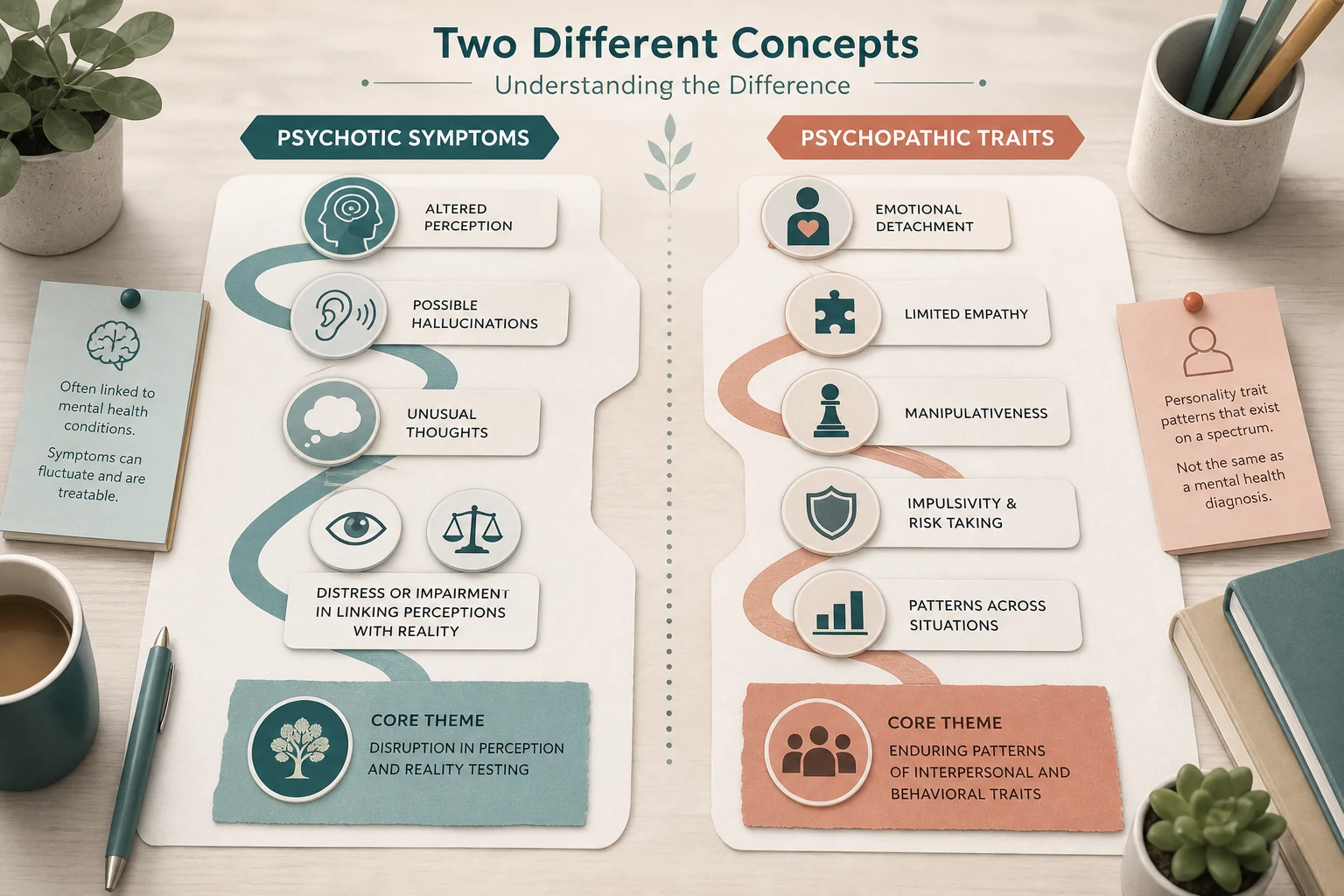
The Short Answer: Reality Testing vs Personality Traits
The simplest difference is this: psychotic refers to a state or episode in which a person may have trouble distinguishing reality from experiences generated by the mind. Psychopathic refers to enduring personality traits related to emotion, behavior, and interpersonal style.
That distinction matters because the two terms point to different kinds of support. A psychotic episode may involve urgent distress, confusion, or safety concerns and often calls for clinical help. Psychopathic traits, by contrast, are usually discussed in relation to long-running behavior patterns: emotional coldness, deceit, risk-taking, charm used for personal gain, or repeated boundary violations.
Here is a practical comparison:
| Term | Main focus | Common examples | What it is not |
|---|---|---|---|
| Psychotic | Contact with reality | Hallucinations, delusions, confused thinking | A synonym for cruel, immoral, or manipulative |
| Psychopathic | Personality and behavior traits | Low empathy, shallow remorse, manipulation, impulsivity | A synonym for hallucinating or having schizophrenia |
| Psychosis | A mental state or symptom cluster | Hearing voices, fixed false beliefs, disorganized speech | Always permanent or always violent |
| Psychopathy | A trait construct used in research and assessment | Callousness, boldness, antisocial behavior patterns | A casual label to place on another person |
This is why "psychotic vs psychosis" is slightly different from "psychotic vs psychopathic." Psychotic is the adjective; psychosis is the broader state or experience. Similarly, "psychopath vs psychopathic" separates a noun people often use loosely from the adjective describing traits. In careful writing, the adjective is usually safer and less stigmatizing.
What Psychotic Means
Psychotic symptoms involve disruptions in perception, belief, thought, or speech. The most familiar examples are hallucinations and delusions. Hallucinations are sensory experiences that feel real without an external source, such as hearing voices or seeing something others do not see. Delusions are strongly held beliefs that remain fixed despite clear contrary evidence.
Psychosis can appear in several contexts. It may be associated with schizophrenia, bipolar disorder, severe depression, substance use, sleep deprivation, medical conditions, or extreme stress. That range is important: psychotic does not mean "bad person," "dangerous person," or "without morals." It describes a reality-processing problem, not a person's character.
People also search for "psychotic vs schizophrenia." Schizophrenia is a specific mental-health condition that can include psychotic symptoms, but psychosis can occur outside schizophrenia too. A person can experience a psychotic episode without having schizophrenia, and a person with schizophrenia is much more than any one symptom.
The safest response to possible psychotic symptoms is not online labeling. If someone is hearing or seeing things others do not, feels intensely paranoid, is unable to sleep, seems very confused, or may be at risk of harm, professional support matters. In urgent situations, local emergency services or crisis care are more appropriate than self-assessment content.

What Psychopathic Means
Psychopathic describes a cluster of personality traits rather than a break from reality. Commonly discussed psychopathic traits include callousness, reduced emotional empathy, shallow remorse, manipulativeness, impulsivity, boldness, and persistent antisocial behavior. In research and forensic settings, psychopathy is often assessed with structured professional instruments, not quick impressions.
Psychopathy is also related to, but not identical with, antisocial personality disorder. Antisocial personality disorder is a formal clinical category centered strongly on repeated violations of others' rights and social rules. Psychopathy is usually broader in trait language, with more emphasis on emotional and interpersonal features such as charm, remorselessness, and low empathy. Some people with antisocial personality disorder may show psychopathic traits, but the terms should not be treated as perfect synonyms.
This distinction explains searches such as "is psychopathy a mental illness or personality disorder." In everyday educational language, psychopathy is best understood as a personality trait construct associated with antisocial and interpersonal patterns. It is not usually presented as a standalone formal category in the same way many readers assume. A licensed clinician would consider history, functioning, context, and multiple possible explanations before making any formal judgment.
If you are reading because of your own patterns, focus on observable traits rather than labels: how you respond to other people's distress, whether you use charm strategically, how often you act without considering consequences, and whether you learn from harm caused. A careful educational psychopathy trait check may help organize reflection, but the value is in insight, not self-stamping an identity.

Psychotic vs Psychopathic vs Sociopath
"Psychotic vs psychopathic vs sociopath" brings three terms into the same search, but they do not sit in the same category. Psychotic is about symptoms that affect reality testing. Psychopathic and sociopathic are about personality and behavior patterns, although sociopath is a looser popular term rather than a precise modern clinical category.
In everyday usage, sociopathic is often used to describe repeated rule-breaking, disregard for others, deceit, aggression, or exploitative behavior. Psychopathic is often used for a more specific pattern that includes emotional coldness, superficial charm, low remorse, and manipulation. But popular usage is inconsistent. Many articles use sociopath and psychopath as if they were separate types, while clinical writing tends to be more cautious.
A better mental model is:
- Psychotic: "Is the person perceiving or believing things that are disconnected from shared reality?"
- Psychopathic: "Are there long-term traits involving low empathy, manipulation, shallow remorse, and antisocial behavior?"
- Sociopathic: "Is someone using an informal term for antisocial behavior patterns?"
This also helps with "psychotic vs sociopathic." A person experiencing psychosis may be frightened, confused, withdrawn, or overwhelmed. That is not the same as using manipulation or violating boundaries. Conversely, a person with strong antisocial traits may understand reality clearly while still behaving harmfully.
Psychotic vs Neurotic: An Older Contrast
"Psychotic vs neurotic" is an older contrast that still appears in search behavior. Traditionally, neurotic referred to anxiety, distress, mood symptoms, or internal conflict while reality testing remained largely intact. Psychotic referred to more severe disruptions in reality testing, such as delusions or hallucinations.
Modern mental-health language has moved away from using neurotic as a broad label for people. It can sound dismissive, and it does not map cleanly onto current categories. Still, the contrast can teach one useful point: emotional distress is not the same thing as losing contact with reality. A person can be anxious, obsessive, depressed, or overwhelmed and still know what is real. A person with psychotic symptoms may have difficulty making that distinction during an episode.
For readers, the practical takeaway is to avoid ranking terms by insult value. These words describe different dimensions of experience. They are not personality attacks.
How to Use These Terms Without Stigma
Because these terms are emotionally loaded, the safest writing and conversation style is specific, observable, and humble. Instead of saying "that person is psychotic," describe the concern: "They seemed to be hearing voices," "They expressed a belief that did not match available evidence," or "Their speech became very hard to follow." Instead of saying "that person is a psychopath," describe the behavior: "They lied repeatedly," "They showed little remorse," or "They ignored clear boundaries."
This wording reduces harm in two ways. First, it avoids portraying people with psychosis as immoral or dangerous. Second, it avoids using psychopathy language as a weapon in ordinary conflict. Many relationship problems involve selfishness, anger, avoidance, trauma, substance use, poor communication, or incompatible expectations. Not all painful behavior points to psychopathy.
If you are concerned about another adult, focus on boundaries and safety rather than amateur classification. Keep records when necessary, seek support from trusted people, and speak with a qualified professional if the situation involves threats, coercion, abuse, or major mental-health changes.
A Practical Self-Reflection Framework
If the keyword "psychotic vs psychopathic" brought you here because you are worried about yourself, pause before choosing a label. Ask three separate questions.
First, are you concerned about reality testing? Examples include hearing or seeing things others do not, feeling certain that ordinary events contain secret messages, or struggling to organize thoughts. These experiences deserve compassionate professional support, especially if they are new, intense, or interfering with daily life.
Second, are you concerned about personality traits? Examples include limited emotional empathy, using people for advantage, frequent impulsive risk-taking, or not feeling much remorse after causing harm. These patterns can be explored through self-reflection, therapy, structured feedback, and behavior change work.
Third, are you reacting to conflict with another person? If so, your first task is not to decide whether they are psychotic, psychopathic, or sociopathic. Your first task is to name the behavior, protect your boundaries, and seek help if you feel unsafe.
For adults who want a structured, private way to reflect on psychopathy-related traits, the Psychopathy Test & AI Insights homepage can be a starting point for education. Treat any result as preliminary information. It should guide reflection and questions, not replace professional care.

FAQ
What is the difference between psychotic and psychopath?
Psychotic is an adjective for symptoms involving a disrupted connection with reality, such as hallucinations, delusions, or disorganized thinking. Psychopath is a commonly used noun for someone thought to show psychopathic traits, such as low empathy, shallow remorse, manipulation, and antisocial behavior. The safer phrasing is usually "psychotic symptoms" or "psychopathic traits," because both reduce labeling.
What are the 7 symptoms of a psychopath?
There is no universal seven-symptom list that can identify a person on its own. Commonly discussed psychopathic traits include reduced empathy, shallow remorse, manipulativeness, superficial charm, impulsivity, irresponsibility, and persistent disregard for others. These traits require context and careful assessment. A checklist on the internet should be treated as education, not a final answer.
What's the difference between psychosis and psychotic?
Psychosis is the broader mental state or symptom cluster. Psychotic is the adjective used to describe symptoms, episodes, or experiences related to psychosis. For example, a clinician might discuss "psychotic symptoms" during a psychotic episode. In everyday language, it is best to avoid using psychotic as an insult.
What is a psychotic person?
"Psychotic person" is not the most respectful phrase. It is clearer to say "a person experiencing psychotic symptoms" or "someone experiencing psychosis." The person may be dealing with hallucinations, delusions, confused thinking, or difficulty separating reality from internal experiences. They deserve support and careful evaluation, not moral judgment.
Is psychopathy a mental illness or personality disorder?
Psychopathy is most often discussed as a personality trait construct linked to interpersonal, emotional, and antisocial patterns. It overlaps with antisocial personality disorder but is not identical to it. In practical terms, psychopathy-related language should be used cautiously, especially outside professional assessment.
Can someone be psychotic and psychopathic?
It is possible for different mental-health symptoms and personality traits to coexist, but the terms still mean different things. A person could have psychotic symptoms and also show antisocial or callous traits, just as someone could have anxiety and a personality pattern. Only a qualified professional can evaluate the full picture.
Does psychotic mean dangerous?
No. Psychotic symptoms do not automatically mean a person is dangerous or immoral. Some people experiencing psychosis may be frightened, confused, or vulnerable. Risk depends on many factors, including distress level, substance use, history, support, and immediate behavior. If there is an urgent safety concern, seek local emergency or crisis support.